

Yoshinobu Yamamoto was so close to baseball perfection: three batters, nine pitches, nine strikes. But thanks to home plate umpire Marvin Hudson, that immaculate inning slipped through his fingers with a jaw-dropping 9th pitch—and trust me, baseball fans, it was one of the most blatant misses you’ll ever see.
The Anatomy of the Robbery
First batter (Bryce Johnson): a 95.2 mph heater in the zone—1–0 called strike. Then a curve for foul (0–2), another curve called (0–3).
Second (Martin Maldonado): foul fastball 0–1, slider called strike (0–2), swinging fastball (0–3).
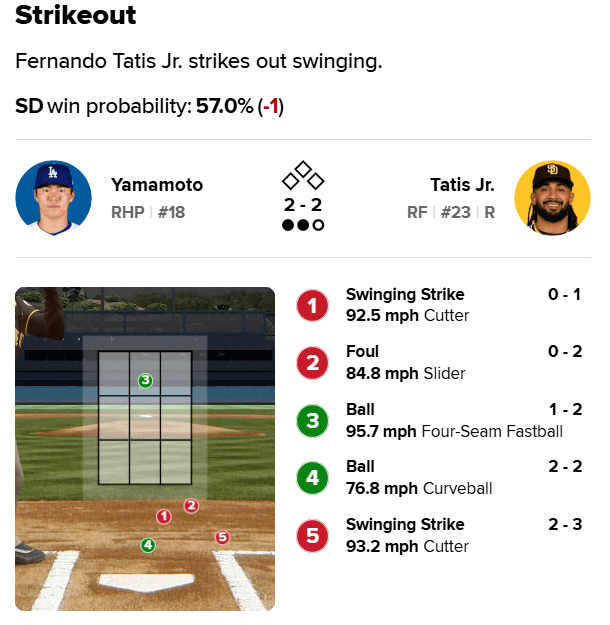
Third (Fernando Tatis Jr.): cutter for swinging strike one, foul slider (0–2), and then… the ninth pitch.
It was a center-cut fastball, buried right over the middle (a little north of center, but not even close to the edge). No sweep from the ump, no argument about size—it was as clear-cut a strike as they come. And yet, Marvin Hudson turned it into ball one, forcing Yamamoto to step off, reset, and take two more pitches to strike out the side. That 9th pitch call crumpled the immaculate bid before it could even land in the record book.
What’s an Immaculate Inning?
It’s the holy grail of pitching dominance: three strikeouts on nine pitches. Since 1889, MLB has logged just 118 immaculate innings across 27,000+ games—about once every 230 games. It’s more exclusive than a no-hitter. Imagine the precision, control, and poise—Yamamoto, one of the elite arms in all of baseball, was literally nakedly denied it.
Yamamoto’s Place in History
In his rising career—two no-hitters in NPB, three Pacific MVPs, a World Series ring, Olympic gold—Yamamoto has never officially notched an immaculate inning. There’s no record of him achieving it in either Japan or MLB . Which makes this near-miss all the more gutting: on this night, this time, he had it. Until the ump’s strike zone betrayed him. C’mon, Blue!
The Call Was Not Close
Let’s be clear as crystal: it wasn’t a borderline pitch. Multiple camera angles showed it bisecting the plate. It trailed the heart of the zone. It was pure, unambiguous strike. A fastball that, if placed in the highlight reel, would be a model of umpiring correctness—one might even say that it caught TOO MUCH of the plate. Except it wasn’t called that way.
A Tale of Bemused Frustration
You feel for Yamamoto. He’s so damn good—95–99 mph heat, devastating breaking stuff, surgical command. He deserves that gem. And to see it slip through because of a human error… it’s maddening. These moments should be celebrated, not obscured. Especially when you’ve executed at the highest level.
So What Happened Next?
Yamamoto shakes it off—he’s built for it. He continued the inning, struck out Tatis on pitch eleven, and ended up with three strikeouts and zero baserunners. But the immaculate inning? That’s a trophy he’ll have to chase again. And if Hudson—or any umpire—lets that situation arise again and flubs it again, heads will roll.
In The Numbers
- 118 immaculate innings in MLB history
- Yamamoto: 0.0 official immaculate innings in MLB or NPB (until Thursday)
- Denied strike #9: a fastball right over the plate
Final Word
Yamamoto’s command and efficiency—nine pitches, nine strikes, three K’s—is the stuff legendary pitchers are made of. To be robbed on the cusp by a strike zone error not only stings; it’s a blip on the game’s integrity. Here’s hoping — no, demanding — that next time the zone reflects what Yamamoto outright earned. And that those nine pitches get forever etched in history, unmarred.
Have you subscribed to the Bleed Los Podcast YouTube channel? Be sure to ring the notification bell to watch player interviews, participate in shows & promotions, and stay up to date on all Dodgers news and rumors!
